
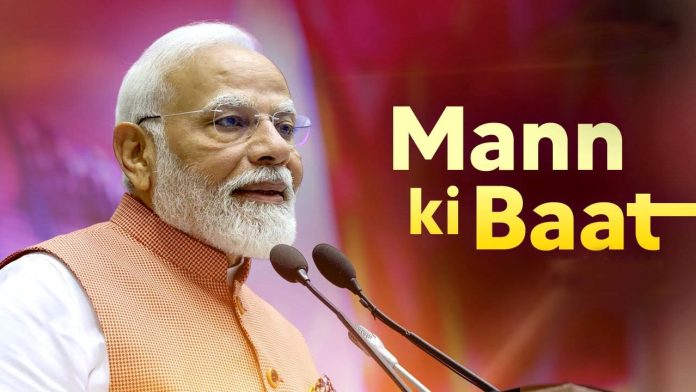
Prime Minister Narendra Modi urged citizens on Sunday to make the 150th anniversary of the national song ‘Vande Mataram’ memorable. He called for a collective effort to uphold the song’s values for future generations.
Speaking in his monthly radio programme ‘Mann Ki Baat’, Modi announced that various programs would take place across the nation to celebrate this significant milestone. The song, written by Bankim Chandra Chattopadhyay, first resonated through the voice of Rabindranath Tagore in 1896, stirring national pride.
During his 30-minute address, the Prime Minister highlighted numerous grassroots initiatives, including the revival of mutated mangroves in Gujarat, the establishment of Garbage Cafes in Chhattisgarh, and the restoration of lakes in Bengaluru. He emphasized the importance of community-led actions that positively impact the environment.
In a commendable gesture, Modi praised the paramilitary forces, particularly the BSF and CRPF, for integrating indigenous Indian dog breeds such as Rampur Hounds and Mudhol Hounds into their units. He shared a commendable story of a Mudhol Hound that recently excelled at an international competition, showcasing the capabilities of local breeds.
“Our indigenous dogs have shown remarkable courage. Last year, during a patrol in a Maoist-affected area of Chhattisgarh, an Indian-bred CRPF dog detected 8 kg of explosives,” Modi asserted, underlining the bravery of these animals.
Modi also announced that some of these Indian breeds will participate in the grand parade at Ekta Nagar, Gujarat, commemorating Sardar Vallabhbhai Patel’s 150th birth anniversary on October 31. This event will serve as a tribute to India’s rich heritage and historical figures.
Highlighting the agricultural potential of India, Modi expressed admiration for farmers in Koraput, Odisha, who have enthusiastically taken to cultivating coffee, which is transforming their livelihoods, particularly for women. He acknowledged their contributions to the local economy.
“Indian coffee — from Chikmagalur, Coorg, Hassan, Nilgiris, Wayanad, and Malabar — is admired worldwide for its diversity and richness,” he added, celebrating India’s agricultural diversity.
The Prime Minister remarked that the rise of social media and digital culture has rejuvenated interest in Sanskrit, depicting how young creators like Yash Salunke leverage platforms to teach this ancient language engagingly.
Extending warm greetings for Chhath Puja, Modi described the festival as an embodiment of devotion, tradition, and affection that fosters India’s social unity. He encouraged citizens to actively participate in this cultural celebration.
“The Mahaparva of Chhath reflects the deep unity between culture, nature, and society,” Modi emphasized, calling for enthusiastic involvement.
Referring to Operation Sindoor, he stated that this campaign has instilled national pride, particularly in areas previously affected by Maoist violence. Modi aimed to inspire hope and resilience among citizens.
“This time, lamps of joy were lit even in areas that had long remained under the shadow of Maoist violence,” he remarked, capturing the transformative impact of community initiatives.
Modi paid tribute to tribal leader Komaram Bheem, recognizing his fight against oppression under the Nizam of Hyderabad as a significant symbol of courage. He also commemorated Bhagwan Birsa Munda, whose birth anniversary — Janajateeya Gaurav Diwas — will be celebrated on November 15.
“Like Birsa Munda and Komaram Bheem, there are many other great luminaries in our tribal communities. I urge everyone to read about them and draw inspiration,” Modi concluded, emphasizing the need to honor India’s diverse historical figures.
In this insightful address, Modi reaffirmed the importance of cultural heritage and community initiatives while encouraging citizens to take active roles in commemorating national pride. The call to celebrate the 150th year of ‘Vande Mataram’ resonates in the heart of the nation’s collective consciousness as India moves forward into a promising future.
