
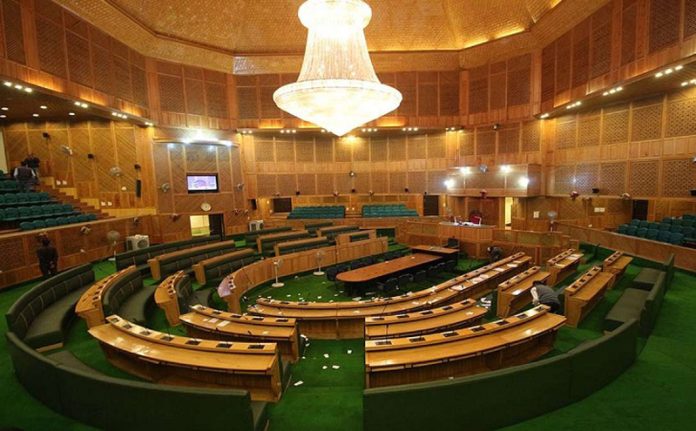
Seven private members’ resolutions have been selected for discussion in the Jammu and Kashmir Assembly on October 29 during the autumn session. This decision follows the submission of 55 resolutions by various legislators, highlighting pressing issues within the Union Territory.
Among the legislators, the BJP contributed the most, with three resolutions admitted, while the National Conference (NC) brought forth two. Additionally, Congress and an Independent legislator each presented one resolution.
Among the crucial resolutions selected, two focus on relief and rehabilitation for families affected by recent devastating flash floods and landslides in Jammu and Kashmir. Another resolution unequivocally calls for the regularization of daily wagers currently serving across different government departments.
BJP MLA Pawan Kumar Gupta from Udhampur West aims to hasten government action regarding the flood and landslide victims. His resolution demands immediate relief measures and urges the state to seek assistance from the Union Government under the National Disaster Relief Fund (NDRF).
“This House urges the Government to ensure adequate compensation and restoration of livelihoods to the affected families,” the resolution asserts. Gupta’s proposal holds Serial No. 3 among the selected resolutions.
Similarly, Balwant Singh Mankotia, another BJP lawmaker from Chenani, has moved a resolution urging the allotment of 10 marlas of land to families that lost their properties during the catastrophic floods of August 2025.
“This House resolves that 10 Marlas of land be allotted for construction of residential houses and cattle sheds for affected families,” his resolution declares, listed at Serial No. 7.
Addressing employment issues, NC MLA Ajaz Jan from Poonch has proposed a key resolution focusing on the regularization of daily wagers within several government sectors. His proposal, positioned at Serial No. 6, emphasizes the necessity for a definitive eligibility framework considering factors such as duration of service and performance.
Additionally, NC legislator Dr. Syed Bashir Ahmed Shah (Veeri) has introduced a resolution aimed at creating employment opportunities for youth, particularly in public and private sectors. This resolution highlights the significance of fostering agro-based industries as a path to sustainable job creation.
Leading the resolutions list is Congress MLA Nizam-ud-Din Bhat. He advocates for establishing a National Law University in Srinagar, asserting the urgency of starting this initiative.
“This House unanimously resolves to initiate the process of establishing the Jammu and Kashmir National Law University at Srinagar without further delay, as funds for the first phase have already been provided,” Bhat states, with his resolution listed at Serial No. 1.
Another notable contribution comes from BJP MLA Rajeev Kumar Bhagat from Bishnah, who ranked his resolution at Serial No. 4. He seeks the revitalization of the Union Territory’s irrigation infrastructure, emphasizing the restoration of canal networks. Bhagat expects this initiative to ensure farmers receive reliable irrigation support, thus enhancing agricultural productivity.
The Independent MLA from Thannamandi in Rajouri district has also put forward a resolution regarding the implementation of the Jammu and Kashmir Panchayati Raj Rules. This resolution, identified as Serial No. 5, calls for adhering to Rule 49 of the J&K Panchayati Raj Rules, 1996. It insists that no contract work amounting to ₹3 lakh should be assigned without involving Halqa Panchayats, ensuring local governance participation.
The Jammu and Kashmir Assembly resumed its session on October 23, focusing initially on obituary references. Following a recess from October 24 to 26, the House plans to resume its activities on Monday, with private members’ resolutions slated for discussion on Wednesday and the session concluding on Friday.
It is noteworthy that none of the three PDP MLAs had their resolutions selected for discussion in this draw, indicating a shift in legislative dynamics. As deliberations continue, the outcomes of these proposed resolutions could significantly impact the region’s socio-economic landscape.
