
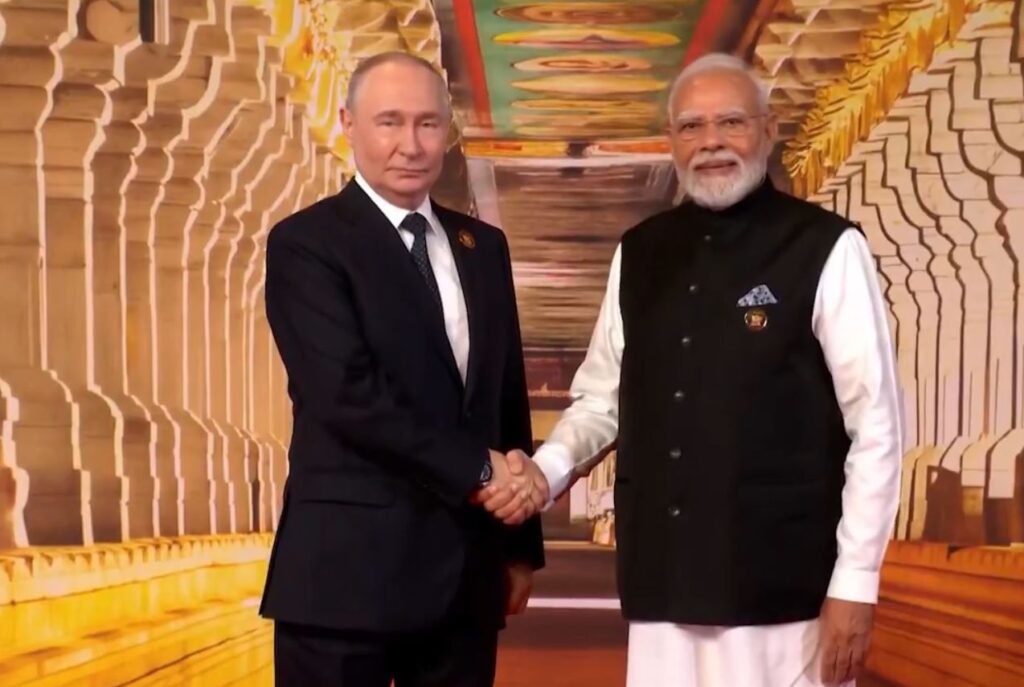
Prime Minister Narendra Modi welcomed Russian President Vladimir Putin on Saturday at Bharat Mandapam in New Delhi, signaling the start of the 18th BRICS Summit. The summit comes under India’s chairship, focusing on enhancing diplomatic ties and multilateral cooperation.
During the ceremonial welcome, PM Modi highlighted the cultural significance of India by greeting BRICS leaders against the magnificent backdrop of the iconic Ramanathaswamy Temple in Rameswaram, Tamil Nadu.
On the eve of the summit, PM Modi engaged in crucial diplomatic discussions with key global leaders. On Friday, he held talks with Iranian President Masoud Pezeshkian and met United Nations Secretary-General António Guterres. In addition, PM Modi addressed the BRICS Business Forum, underscoring India’s commitment to fostering economic partnerships.
The meeting between Modi and Putin marks their second encounter this year, following their discussions at the 26th SCO Summit held in Bishkek in August. The two leaders examined the breadth of India-Russia cooperation spanning various sectors: political, economic, defence, energy, space, skill mobility, and people-to-people exchanges.
The Ministry of External Affairs (MEA) stated that the dialogue also encompassed India’s pivotal role in BRICS and its increasing engagement on multilateral platforms. They addressed pressing regional and global concerns including conflicts in West Asia and the ongoing situation in the Black Sea region.
A noteworthy diplomatic achievement during this summit includes the consensus reached on a Joint Statement by BRICS nations. The negotiations, which persisted into the early hours of Saturday, demonstrated India’s leadership in navigating complex discussions among member countries.
Amidst varying opinions and contentious issues, India spearheaded extensive consultations to bridge differences and achieve a unified stance. This collaboration among BRICS member states highlights their commitment to collective dialogue and cooperative solutions.
As the summit continues, analysts suggest that the outcomes will not only shape the future of BRICS but also reflect broader geopolitical trends affecting Asia and beyond. The collaborative spirit exhibited during the summit signals a resilient partnership among emerging economies striving for equitable global governance.
